The cost of unstructured procurement is not always visible in a single line item. It accumulates in maverick spending, untracked commitments, approval cycles managed through email, and supplier relationships that live entirely in individual inboxes. When finance teams try to report on committed spend at period-end, they discover that purchase obligations made through informal channels never appear in any system until the invoice arrives. In 2026, organizations that formalize their procurement process gain spend visibility and contract leverage that informal purchasing cannot deliver. This guide walks through how to build a procurement process that scales, from intake to payment.
What a Modern Procurement Process Looks Like
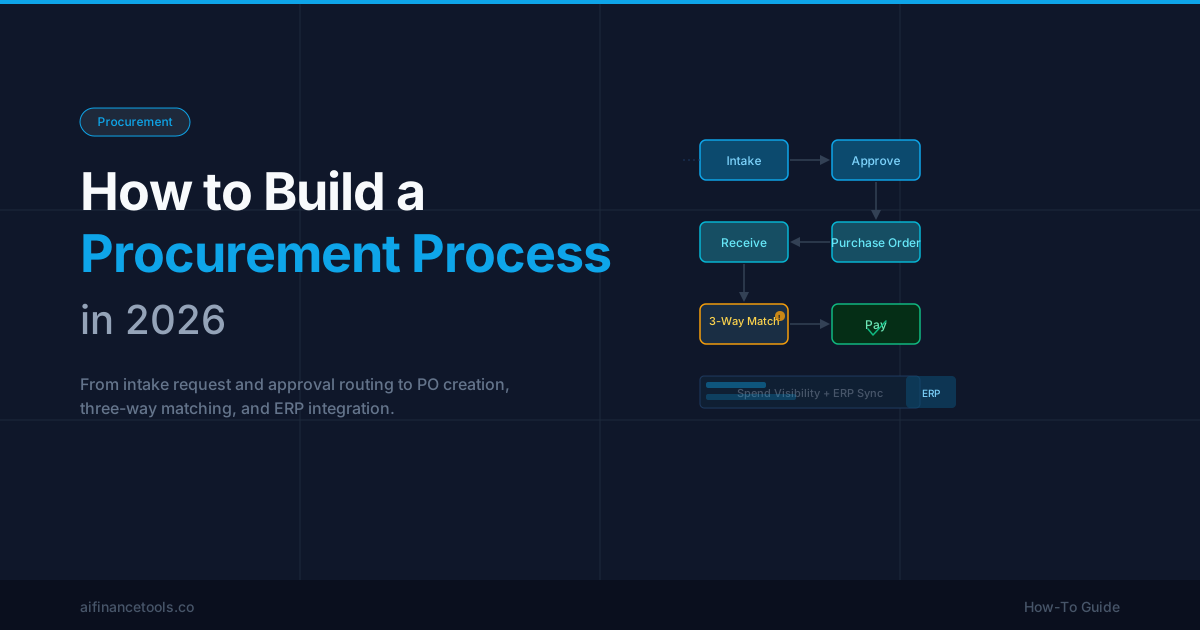
A well-structured procurement process covers six stages in sequence: intake request, approval, purchase order creation, receipt confirmation, invoice matching, and payment. Each stage exists for a specific control reason.
The intake stage captures what is being purchased, from whom, at what cost, and against which budget before any commitment is made. This pre-commitment visibility is what separates procurement from reactive invoice processing. Without it, finance teams can only see spending after it has already been committed — often after the period has closed.
The approval stage routes the request through the right reviewers based on value, vendor, and budget ownership. A well-designed approval matrix makes routine purchases fast and ensures that high-value or high-risk purchases get appropriate scrutiny without creating a blanket bottleneck on everything.
The purchase order formalizes the commitment: it documents what was agreed, at what price, and creates the legal and accounting record that the invoice will eventually be matched against. Organizations without a PO discipline have no systematic way to catch invoice discrepancies.
Three-way matching — comparing the purchase order, the receipt of goods or services, and the supplier invoice — is the primary control against invoice fraud and accidental overpayment. It is the stage most commonly skipped in informal procurement, and the one that causes the most downstream accounting problems.
Steps to Build Your Procurement Process
Step 1: Define Your Intake and Request Process
The first design decision is how employees submit purchase requests. Define what information is required at submission: vendor name, amount, business justification, GL code, cost center, and any supporting documentation. Keep the required fields to the minimum necessary for approval routing — every additional required field reduces adoption.
The intake interface is the adoption bottleneck. If submission requires logging into an unfamiliar system, navigating a lengthy form, or waiting for IT provisioning, employees will route purchases through email instead. Design the intake path with the submitting employee's experience as the primary constraint, not the approver's.
Step 2: Establish Approval Hierarchies
Document your approval matrix before configuring any system. A typical structure tiers approvals by value: purchases below a threshold auto-approve or route to the direct manager; purchases above a higher threshold route to finance; large or strategically significant purchases involve the CFO or executive sign-off.
Add risk-based routing on top of value-based routing where needed: new vendor relationships may require additional review regardless of amount; spend in sensitive categories (legal, compliance, data vendors) may need specialized approvers. Document exceptions explicitly — undefined edge cases become approval bottlenecks after launch.
Step 3: Set Up Supplier Management
Maintain a preferred supplier list: approved vendors with negotiated terms, payment conditions, and contact records. Supplier onboarding should capture tax form documentation (W-9 for US vendors, W-8BEN for international), banking and payment information, and any compliance checks required by your industry or geography.
Supplier record discipline prevents the duplicate vendor problem that plagues organizations that grew without formal procurement: multiple records for the same vendor under different name variations, creating payment confusion and reporting inaccuracies. Establish a deduplication standard before migration.
Step 4: Implement PO Creation and Three-Way Matching
Purchase orders should be generated automatically from approved requests and transmitted to suppliers without manual re-entry. The PO documents the agreed terms: item description, quantity, unit price, delivery date, and payment terms.
When the supplier invoice arrives, it should be matched against the open PO and, where applicable, against a receipt confirmation that the goods or services were delivered as specified. Exceptions — where invoice amount differs from PO amount by more than a tolerance threshold — route to a dedicated exceptions workflow rather than blocking the entire invoice queue. Define exception thresholds and routing before launch; without them, every minor variance becomes a manual escalation.
Step 5: Build Spend Visibility and Reporting
Category spend reports, vendor concentration analysis, and budget-versus-committed comparisons are the outputs that justify the process investment. Committed spend — approved purchase orders not yet invoiced — is the visibility gap in most organizations operating without formal procurement. Tracking committed spend prevents the end-of-period budget surprise where obligations already made exceed what was anticipated.
Design reports for the audiences that will actually use them: department managers need budget-versus-committed by cost center; finance needs vendor exposure and payment timing; leadership needs category and total spend trends. Build the report structure into the process design, not as an afterthought after the system is live.
Step 6: Integrate with Your ERP or Accounting System
Procurement data has no accounting value until it flows into your general ledger. Purchase orders, three-way matching results, and approved invoices need to sync with your accounting system — QuickBooks, Xero, NetSuite, SAP, or Oracle — so that committed obligations appear in financial reporting and approved invoices move to payment without manual re-entry.
Confirm whether the integration is bidirectional or one-directional before committing to a procurement tool. One-directional export (procurement to accounting) is common and sufficient for most workflows. Bidirectional sync — where vendor master data, chart-of-accounts updates, and payment confirmations also return from the ERP — is more powerful but requires more configuration and maintenance.
When to Bring in Software
A manual procurement process managed through email and spreadsheets is viable at very small scale — under ten employees with straightforward purchasing. Beyond that, the tracking and reporting overhead grows faster than the team's capacity to manage it manually, and audit readiness becomes a practical problem.
When purchase request volume outgrows email management and spreadsheet tracking, dedicated software creates the audit trail, reporting, and exception handling that informal systems cannot provide.
For small and mid-size teams setting up their first formal process, Precoro offers a practical path from zero to functional PO workflows, with accessible setup and solid integrations to common accounting platforms.
For teams that want a modern intake experience with complex approval routing across departments, Zip has built a strong reputation for making the employee-facing request process fast and low-friction — a critical factor in achieving adoption.
For organizations with significant sourcing volume — teams running regular RFQ processes for commodity or recurring purchases — Fairmarkit applies AI to supplier discovery and bid comparison, reducing the manual overhead of running competitive bidding at scale.
For a structured comparison of procurement platforms across company sizes and use cases, see our best procurement software evaluation.
Common Pitfalls to Avoid
Launching the system before the approval matrix is defined is the most common implementation failure. Teams configure the software, go live, and then discover that the approval logic does not match how decisions actually get made — which requires rebuilding the configuration after rollout, often with lower user trust.
Requiring too many fields on intake forms kills adoption immediately. Start with the minimum viable field set — vendor, amount, justification, cost center — and add fields only when the absence of specific data creates a recurring problem.
Not connecting procurement to the accounting system creates a split-brain environment: procurement data lives in one tool, accounting data in another, and finance spends meaningful time each period reconciling between them. Integration is not optional for organizations where procurement volume is material to financial reporting.
Building for aspirational process complexity rather than current reality is the enterprise trap for mid-market buyers. A system configured with ten approval tiers and complex supplier scoring rubrics, deployed to a team that previously managed everything through email, will be worked around within weeks. Start with the process you can sustain, and extend complexity only when the simpler version has reached its limits.
The payoff from a formal procurement process compounds over time. Start with centralized intake, a documented approval matrix, and preferred supplier records. Add PO automation and three-way matching when invoice volume makes manual reconciliation a consistent source of errors. Introduce ERP integration when committed spend visibility becomes material to financial reporting accuracy.