Traditional AP automation—built on OCR to capture text from invoice images, rules engines to validate field values, and RPA to move data between systems—has delivered real efficiency gains for finance teams over the past decade. But it works within narrow tolerances. When an invoice arrives with a non-standard format, a line description that does not match the purchase order exactly, or an amount that deviates by a margin the rules engine was not configured to handle, the document either fails validation and queues for manual review or passes through with an undetected error. The exception rate is the practical ceiling of rules-based automation.
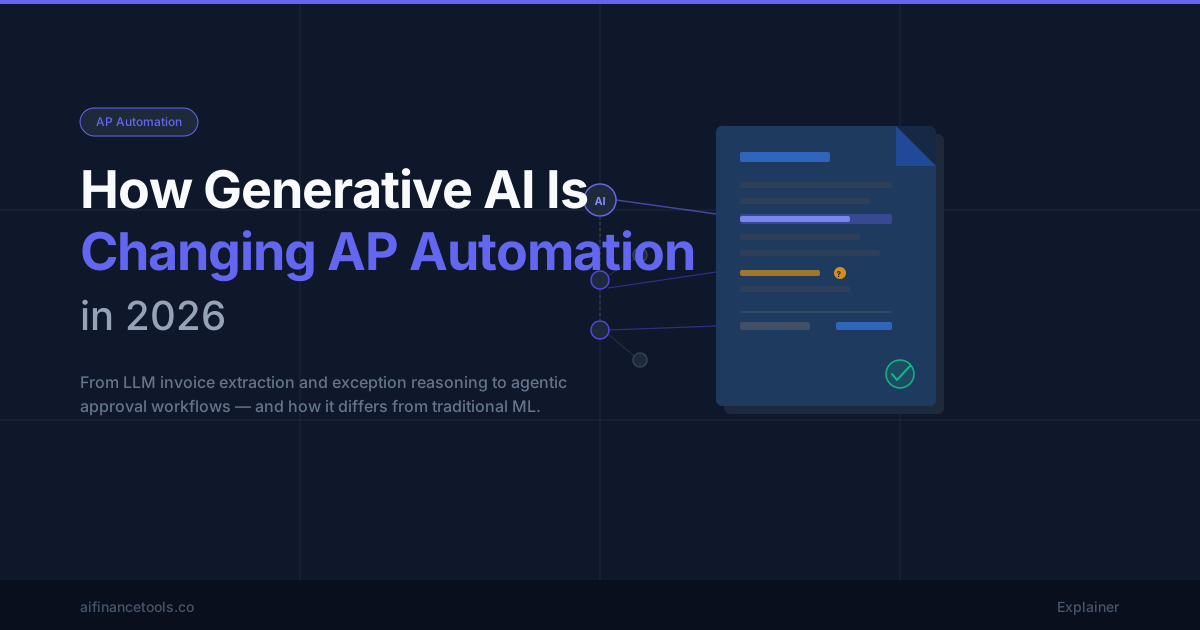
Generative AI introduces a different architecture. Rather than matching extracted values against predetermined rules, large language models (LLMs) interpret unstructured document content contextually—understanding that "professional services rendered Q2" and "consulting fees April through June" describe the same thing, or inferring that a missing PO number likely corresponds to a specific open order based on vendor, amount, and date. This contextual reasoning capability is the core of what makes 2026 a meaningful inflection point in what AP automation can realistically handle without human intervention.
What Makes Generative AI Different from Traditional AP Automation
Traditional AP automation stacks operate sequentially: OCR extracts text from the document, rules validate fields against expected values, and exceptions that fail validation enter a manual review queue. The accuracy ceiling is set by the consistency of incoming invoices. High-volume, same-format invoices from recurring vendors work well. Non-standard invoices from infrequent vendors, invoices with variable line-item structures, or documents with ambiguous or missing fields routinely fall out of the automated path regardless of how the rules engine is tuned.
Generative AI—specifically the large language models underlying purpose-built financial AI systems—approaches the same document differently. Rather than extracting fields positionally ("the number in this location is the invoice total"), an LLM interprets the document semantically. It understands what fields mean, recognizes equivalent expressions for the same concept, and can reason about what is likely true when a field is absent or expressed in an unexpected way.
The practical result is a higher straight-through processing rate on non-standard invoices. An LLM can handle variation in vendor invoice formats without requiring format-specific template training for each new vendor, because its general language understanding already encompasses the semantic range of how AP concepts are expressed across document types.
This is a meaningfully different capability from what AP-specific machine learning has historically delivered—a distinction explored in more detail below.
How Generative AI Works Across the AP Workflow
LLM Invoice Data Extraction and Coding
When an invoice arrives, generative AI can extract structured data—invoice number, date, vendor name, line items, amounts, tax, payment terms—from unstructured formats without requiring vendor-specific templates. The LLM reads the document as a whole, identifies the relevant fields semantically, and produces a structured output that maps to the accounting system's data model.
GL coding is one of the more consequential applications. Traditional automation relies on vendor-to-GL mapping tables that finance teams must maintain manually as vendors, product lines, and chart-of-accounts structures change. An LLM can reason about what an expense description means and suggest the appropriate GL account based on line item content, vendor category, and historical coding patterns—flagging low-confidence suggestions for human review rather than forcing a classification.
GenAI Exception and Discrepancy Handling
When a three-way mismatch occurs between a purchase order, a receipt, and an incoming invoice, traditional automation creates an exception record and queues it for manual review. Generative AI can do more: it can analyze the discrepancy, consider context (is this within the vendor's typical billing tolerance? does the price deviation correspond to a rate adjustment that appeared in recent correspondence?), draft an explanation of the likely cause, and suggest a resolution path—all before a reviewer opens the record.
This does not eliminate human review of exceptions, but it compresses the time each exception requires. Rather than diagnosing the discrepancy from scratch, the reviewer reads a pre-prepared summary with a suggested resolution and approves or overrides it. For teams processing high exception volumes, this is where generative AI delivers the most direct throughput improvement.
Drafting Vendor Communications and Summaries
Generative AI can draft outbound vendor communications—payment status responses, dispute acknowledgments, requests for corrected invoices—from structured AP data without requiring staff to compose each message. For teams managing high volumes of vendor inquiries, this reduces the labor involved in routine correspondence while keeping responses consistent in content and tone.
Summary generation makes AP data accessible to stakeholders who need situational awareness without navigating the AP system directly. A generative AI layer can produce a readable digest of invoice activity, open exceptions, or upcoming payment obligations from structured data, formatted for the audience rather than requiring them to interpret raw system output.
Agentic AI and Approval Flow Automation
Agentic AI represents the most significant capability extension entering wider deployment in 2026. Rather than generating content for a human to act on, an agentic system can execute decisions within a defined operating envelope autonomously. In AP, this means an agentic workflow can match invoices to purchase orders, apply routing logic, request additional information from suppliers directly, and advance invoices through the approval process without requiring a human touchpoint at each step.
The operating parameters matter more than the autonomy itself. Agentic AP automation that functions reliably is constrained by policy: it operates on invoices within defined value thresholds, from approved vendors, with matching POs, and within configured tolerance rules. Outside those parameters, it escalates to a human approver rather than deciding autonomously. The risk of unconstrained agentic decision-making in a payment workflow is real; the value comes from well-designed guardrails, not from maximizing the scope of autonomous action.
Machine Learning vs Generative AI in AP
The terms are often conflated in vendor marketing when they describe meaningfully different capabilities. The distinction matters for evaluating what a platform actually does versus what it claims.
Machine learning in AP has historically referred to predictive and classification models: a model trained on historical invoice data learns which invoices should be coded to which GL account, which approver a given invoice type should route to, or which invoices exhibit characteristics statistically associated with fraud or duplicate submissions. These models are effective at classifying and predicting within the range of patterns present in their training data. They improve with more data and degrade when patterns shift materially.
Generative AI does something different: it understands and generates language. Rather than classifying an invoice against a learned pattern, it interprets the document the way a knowledgeable reader would—using general language understanding to handle variation, ambiguity, and formats it has not seen before, without task-specific retraining.
In practice, modern AP platforms increasingly use both in combination. ML models handle pattern-based prediction: anomaly scoring, duplicate detection, routing classification, payment timing optimization. Generative AI handles interpretation, exception explanation, coding suggestion from line-item description, and communication drafting. The two capabilities are complementary rather than competitive, and platforms that use only one of them are working with a subset of what the current architecture makes possible.
Choosing Tools That Use Generative AI
Not all platforms that describe themselves as AI-powered have incorporated generative AI into their core processing. The question to probe in any evaluation is whether the platform uses LLMs for document interpretation and exception reasoning, or whether "AI" refers to ML-based classification that has been in the AP market for several years under the same label.
Among the platforms most directly associated with generative and AI-native AP processing, Vic.ai has built its architecture around autonomous invoice processing using deep learning and LLM-based interpretation—one of the clearer examples of what a generative AI-first AP platform looks like in production. Stampli integrates AI into collaborative invoice review, applying it to surface context, suggested coding, and approval routing within a human-in-the-loop workflow. Tipalti applies AI at the payment and compliance layer—tax form management, payment method optimization, and supplier fraud detection—alongside its core AP automation.
For a direct comparison of how an AI-native AP approach differs from a more traditional AP ecosystem, the Bill vs Vic.ai evaluation examines that question specifically. For a broader comparison across the AP automation category, the best AP automation software evaluation covers platforms across generative AI depth, payment capabilities, and buyer fit.
What to Watch in 2026
Generative AI in AP is producing measurable results on well-defined tasks—non-standard invoice extraction, exception explanation, GL coding suggestion from description—but its deployment introduces considerations that teams should address explicitly rather than inherit by default.
Accuracy is not uniform across document types. An LLM that performs reliably on English-language invoices from established vendors may perform less reliably on invoices in other languages, with non-Western date or number formats, or from vendor categories underrepresented in its training. Testing with your actual invoice mix—not a vendor-supplied benchmark dataset—is the only way to establish realistic straight-through processing expectations before committing to automation targets.
Agentic workflows require governance design before deployment, not after. Defining the operating envelope—what the system can decide autonomously versus what requires a human approval—is a policy and design exercise, not a configuration default. Teams that deploy agentic AP automation without explicit policy boundaries typically encounter autonomous decisions outside the intended scope that erode confidence in the system and require rollback.
Human review remains a design element, not an afterthought. Generative AI compresses the time and cognitive load of AP review; it does not eliminate the judgment required for high-value invoices, first-time vendor relationships, or exceptions with material financial consequences. The well-implemented version of generative AI in AP is one that handles routine volume at scale and escalates the cases that genuinely require human judgment—not one that attempts to decide everything autonomously.
The trajectory through 2026 is toward agentic AP workflows that handle a larger share of straight-through processing while routing a narrower set of well-defined exceptions to human reviewers. The organizations that benefit most will be those that invest in defining the boundaries clearly before expanding the scope of autonomous action.